
Housecall Pro alternatives
The four reasons shops actually leave, seven places they go, and the migration steps that decide whether the switch is worth the month it costs you.
Most companies leave Housecall Pro for one of four reasons: per-user pricing plus add-on modules, dispatch that cannot hold a real board, reporting that will not cost a job, or the phone.
Match the destination to the reason. Cost points to Service Fusion. Simplicity with more room points to Jobber or FieldPulse. A phone-only problem points to Workiz, which is the same tier as Housecall Pro on the work side but takes inbound seriously.
If it is the dispatch ceiling and the phone, which is the common case at this stage, only ServiceTitan and Notifi cover both from one record, and ServiceTitan runs roughly $2,450 to $3,980 a month at ten technicians before implementation. We build Notifi. That narrow field is why. If you cannot name your reason in one sentence, stay put for now.
Housecall Pro is good software. Here is when it stops fitting
Worth saying plainly: Housecall Pro is one of the best-designed products in the trades and it is the reason a lot of shops got off paper at all. Most companies that leave are not leaving because it is bad. They are leaving because they changed.
The four reasons that come up most:
- The bill tracks your headcount. Per-user pricing plus modules means every hire raises your software cost, and capability you assumed was included turns out to be a separate line.
- Dispatch cannot hold a real board. It is built to schedule appointments, not to re-solve an afternoon when a job runs two hours long.
- Reporting will not cost a job. Once you are making decisions from margin by job type, the numbers you need are not there.
- The phone. Housecall Pro does not answer it, and by the time you are big enough for this to hurt, it hurts a lot.
If none of those is true for you, stay. Switching costs you a month of disruption and there is no prize for running more sophisticated software than your operation needs.
Where people go, and what it costs
| Why people move to it | At 10 technicians | G2 | Trade-off | |
|---|---|---|---|---|
| Housecall Pro | The baseline you are leaving | $399 per month, MAX plus 2 users | 4.3 (204) | Per-user pricing plus paid modules, thin reporting, no answering |
| Jobber | Similar simplicity, stronger scheduling and client communication | $299 per month | 4.6 (509) | Same ceiling arrives later, not never |
| FieldPulse | More depth on estimates and price book for the money | Quote only | 4.7 | Reporting and multi-location still maturing. Does not publish pricing |
| Service Fusion | Cost stops tracking headcount | $208 to $533 per month, unchanged by headcount | 4.1 | Less polish, smaller integration surface |
| Workiz | The phone comes inside the software, same tier on the work side | Base plus about $30 per additional user | 4.5 | Starter-tier dispatch and reporting, so the ceiling arrives at the same size |
| FieldEdge | Trade-specific depth and QuickBooks Desktop sync | Quote only | 4.1 (83) | Dated interface, weaker mobile, no AI front office |
| ServiceTitan | The capability ceiling disappears | $2,450 to $3,980 per month, plus implementation | 4.5 (371) | Per-technician pricing and a real implementation project |
| Notifi | Front office and the work in one system, no add-on modules | Quote only | 5.0 (3) | More system than a small shop needs. No published price table |
The number that surprises people is the jump. Housecall Pro at ten technicians is around $399 a month at list. ServiceTitan at the same size is roughly $2,450 to $3,980 before the implementation fee. That is not a like-for-like upgrade, it is a different category of spend, and it is why the middle of this table exists.
The move most people make, and the one they should consider
The default move is Housecall Pro to Jobber, or Housecall Pro to ServiceTitan. Both are reasonable and both have a predictable failure mode.
Jobber solves the immediate irritation and postpones the real one. If you left because of the ceiling, you have bought yourself eighteen months and the same conversation.
ServiceTitan removes the ceiling entirely and replaces it with a different problem: a per-technician bill and an implementation that needs an owner. Companies that make this jump too early tend to use a fraction of it.
The option most people do not consider is fixing the leak rather than upgrading the tier. If what is actually costing you money is unanswered calls and follow-up that never happens, a bigger scheduling system does not address it.
Two platforms on this list put the front office inside the software rather than sell it separately. Workiz is the cheaper one, and it is an honest phone upgrade, but on the work side it is Housecall Pro's tier, so you land back here in eighteen months with the same dispatch and reporting ceiling. Notifi is the one that changes both at once, which is the whole reason to make a move this disruptive rather than a lateral one.
We build Notifi, so discount that accordingly. The test is simple enough to run yourself: ask each vendor what their AI knows about a repeat customer at the moment it picks up the phone. The answers separate quickly.
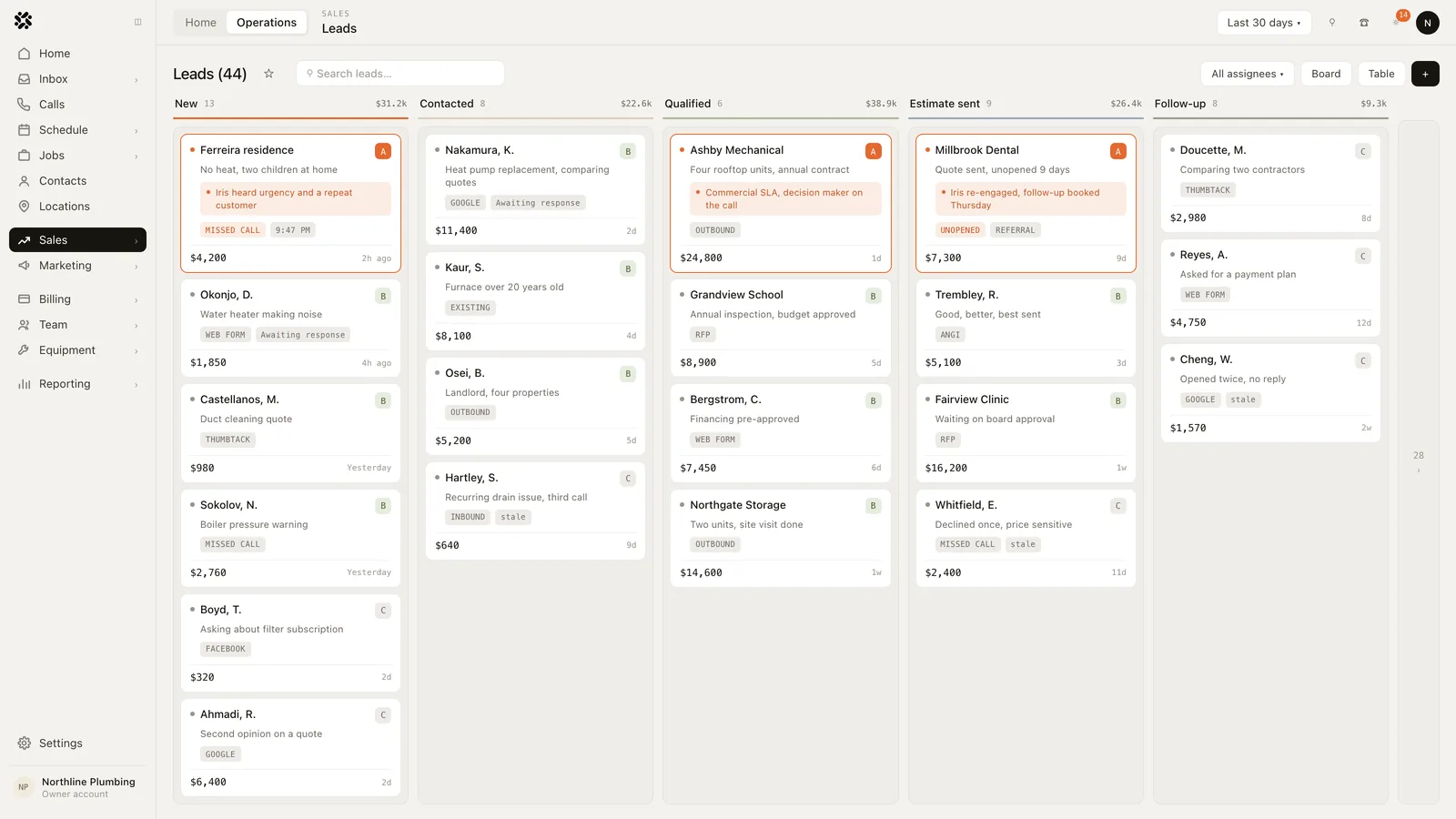
Run that test on us first
Take the tour and watch Iris pick up a call from a repeat customer, or bring a week of your own calls and we will run Notifi against them.






What to get right in the migration
- Clean the customer data before you move it, not after. Duplicates multiply on import and every one of them costs you later.
- Rebuild the price book rather than porting it. Most shops are carrying items they have not sold in two years.
- Keep read access to the old system for a full year. Warranty questions and disputes reach back further than you expect.
- Move in a shoulder season, and if you cannot, pilot on one crew first.
- Get your technicians in early. The migration that fails is the one where the field finds out on go-live day.
Where these numbers come from
Pricing and review figures checked August 2026. List prices are before annual discounts and add-ons, and vendors change them without notice. Verify anything you are about to make a decision on.
Common questions
What is the best alternative to Housecall Pro?
For most shops leaving on simplicity and cost, Jobber and FieldPulse are the direct comparisons. If per-user pricing is the problem, Service Fusion. If only the phone is the problem, Workiz, though it is Housecall Pro's tier on the work side. If you have outgrown the whole tier and the phone is leaking, ServiceTitan or Notifi, depending on whether you want an implementation project and a per-technician bill.
Is Jobber better than Housecall Pro?
Not better, different. Jobber tends to be stronger on scheduling depth and client communication, Housecall Pro on the consumer-facing experience and the technician app. Shops that switch between them usually report a lateral move rather than an upgrade, which is worth knowing before you spend a month on it.
Why does Housecall Pro get expensive?
Two things compound. Pricing is per user, so cost follows hiring, and several capabilities are sold as add-ons rather than included. A shop that started on a small plan can find the bill has grown faster than the crew did.
How hard is it to migrate off Housecall Pro?
Customers, jobs and invoices export cleanly enough. The parts that take real work are the price book, recurring service agreements and any automation you built. Budget four weeks for a mid-size shop and do the data cleanup before the import rather than after.
Should we switch to ServiceTitan?
Only if you have someone whose job will include running it. ServiceTitan rewards companies that invest in operating the system. Without that person you tend to pay enterprise money for a fraction of the platform, which is the most common regret we hear.
See what the switch would actually look like
Bring your current setup and a real week of work. We will show you the migration honestly, including the parts that are a nuisance.