
ServiceTitan alternatives, compared honestly
Eight platforms, what each one is genuinely good at, and the size and trade mix where each stops making sense. We make one of them, and we have said where the others win.
It depends on one thing: whether you still need the platform to answer your phone. If you do not, this is easy. BuildOps for commercial mechanical. Jobber or Housecall Pro under about five trucks. Service Fusion if per-user pricing is what is hurting. FieldPulse for depth on a budget.
If you do need both, the field is much smaller than this list suggests. Only three of the nine run the work properly and answer the phone from inside the same record: ServiceTitan, BuildOps and Notifi. BuildOps is commercial. ServiceTitan runs roughly $2,450 to $3,980 a month at ten technicians before implementation. For a residential shop past starter software, that arithmetic is why we built Notifi, and it is the honest case for us rather than a claim that we beat everyone at everything.
Why people leave ServiceTitan
It is rarely because the software cannot do the job. ServiceTitan is the most capable platform in the category and nobody serious disputes that. People leave for four reasons that come up again and again:
- The bill grows with every truck. ServiceTitan is priced per technician, so the cost curve follows your headcount rather than your profit.
- Implementation is a project, not a setup. Onboarding fees are commonly reported from around $5,000 into the tens of thousands depending on scope, and the calendar runs in months.
- The modules add up. Capability you assumed was included often turns out to be a separate line.
- It needs an owner. Getting real value out of it assumes someone on staff whose actual job is running the system.
If none of those describe you, stay. Switching field service software is genuinely painful and you should only do it for a reason you can say out loud in one sentence.
What each one actually costs
The most useful thing nobody publishes is the same operation priced across all of them. Below is entry pricing, how the bill grows, and what ten technicians would cost at list price. Four of the nine do not publish pricing at all, and we are one of the four, so treat those rows as the gap they are.
| Entry price | How the bill grows | Onboarding fee | At 10 technicians | |
|---|---|---|---|---|
| ServiceTitan | Not published. Reported $245 to $398 per field technician per month | Per field technician | Reported $5,000 to $50,000+ | $2,450 to $3,980 per month, plus implementation |
| Jobber | $29 per month solo Core. $149 per month for 5 users | Per user. $29 per extra user | None | $299 per month |
| Housecall Pro | $79 per month Basic. $189 per month Essentials, up to 5 users | Per user. $35 per user beyond the 8 included on MAX | None | $399 per month, MAX plus 2 users |
| FieldEdge | Not published. Quoted | Per user | Quoted | Quote only |
| Service Fusion | $208 per month Starter, up to $533 per month | User count not metered | Quoted | $208 to $533 per month, unchanged by headcount |
| Workiz | Roughly $187 to $270 per month across tiers | Per user. About $30 per extra user | Quoted | Base plus about $30 per additional user |
| BuildOps | Not published. Quoted | Quoted | Quoted | Quote only |
| FieldPulse | Not published. Reported $99 to $399 per month | Per user | Quoted | Quote only |
| Notifi | Not published. Quoted per business | Quoted per business, no add-on modules | Included in onboarding | Quote only |
Two things jump out. ServiceTitan is an order of magnitude apart, because it is the only one priced per field technician, so ten trucks means ten multiples before the implementation fee. And Service Fusion is the only one where the number does not move when you hire, which is why it keeps showing up for teams with a lot of office staff.
Worth being precise about one thing, because it gets repeated wrongly everywhere including in an earlier version of our own comparison page: ServiceTitan bills per field technician. Office staff, dispatchers and CSRs are generally not billed the same way. "Every user is another licence" is not an accurate description of their model, and you should discount any comparison that tells you it is.
How they are rated, and what they do
This is not a ranking by quality, because the best platform depends almost entirely on your size, your trade mix and where your money is leaking. Read the fit column first, then the review counts.
| G2 | Capterra | Tier | Best fit | |
|---|---|---|---|---|
| ServiceTitan | 4.5 (371) | 4.3 (308) | Enterprise | Large operations with someone on staff who owns the system |
| Jobber | 4.6 (509) | 4.6 (1,373) | Starter | One to fifteen technicians who want simple and reliable |
| Housecall Pro | 4.3 (204) | 4.7 (2,736) | Starter | Small residential shops that value the consumer-grade app |
| FieldEdge | 4.1 (83) | Not verified | Mid-market | HVAC and plumbing shops tied to QuickBooks Desktop |
| Service Fusion | 4.1 | 4.3 | Mid-market | Dispatch-heavy teams with a lot of office staff |
| Workiz | 4.5 | Not verified | Starter | Small to mid-size shops where the phone is the loudest problem |
| BuildOps | Not verified | Not verified | Mid-market | Commercial contractors, especially mechanical |
| FieldPulse | 4.7 | 4.6 (368) | Mid-market | Growing shops that want more than Jobber without an implementation |
| Notifi | 5.0 (3) | No reviews yet | Mid-market | Shops past starter software losing money on the phone |
01Jobber
The most common landing spot for people leaving ServiceTitan because it got too heavy. Clean, dependable, genuinely easy to train on. It added native route optimization in 2025, which closed one of the bigger gaps.
One to fifteen technicians. Residential service and maintenance work where the schedule is the main thing you are managing.
You will feel the ceiling on dispatch depth, reporting and anything multi-location. If you left ServiceTitan because you outgrew Jobber in the first place, this is a circle.
02Housecall Pro
The friendliest app in the category and the easiest sell to a technician who hates software. Strong on consumer-facing touches like booking and reminders.
Small residential shops where the owner is still in the field and the customer experience is the differentiator.
Costs climb as you add people and turn on modules. Contractors regularly report the Android app lagging iOS, and the reporting is thin once you want job costing.
03FieldEdge
Built for HVAC and plumbing specifically rather than for service businesses generally. The QuickBooks Desktop sync is the real reason most people pick it.
Established HVAC and plumbing companies whose accounting lives in QuickBooks Desktop and is not moving.
The interface shows its age, and the mobile experience is behind the newer platforms. There is no AI front office.
04Service Fusion
The pragmatic pick when your headcount is growing faster than your revenue, because you are not billed per person logging in.
Dispatch-heavy teams with a lot of office staff who would otherwise be paying per seat.
Less polish than the newer platforms and a smaller integration surface. Not a strong fit for commercial service agreements.
05Workiz
Best understood as Housecall Pro's tier with the phone taken seriously. Built-in VoIP, call tracking and AI call handling inside the same product that schedules the work, which genuinely puts it ahead of Jobber and Housecall Pro on inbound.
Small to mid-size residential shops where the phone is the loudest problem and the schedule is still manageable.
The work side is starter-tier, so the dispatch depth and reporting ceiling arrive at the same size they would with Housecall Pro. The AI handles and tracks calls rather than running intake against the live schedule. It fixes the phone without fixing what happens after it.
06BuildOps
The strongest AI-native option in the category, and the most honest about who it is for. BuildOps says plainly that it is purpose-built for commercial contractors.
Commercial mechanical, and contractors running large service agreements across many sites.
If you are primarily residential, you are not the customer they built it for, and you will feel that in the workflows.
07FieldPulse
A capable middle option that has been adding depth quickly. Good estimates and price book handling for the money.
Growing shops that want more than Jobber without an enterprise implementation.
Still maturing on reporting and multi-location. No AI front office.
08Notifi
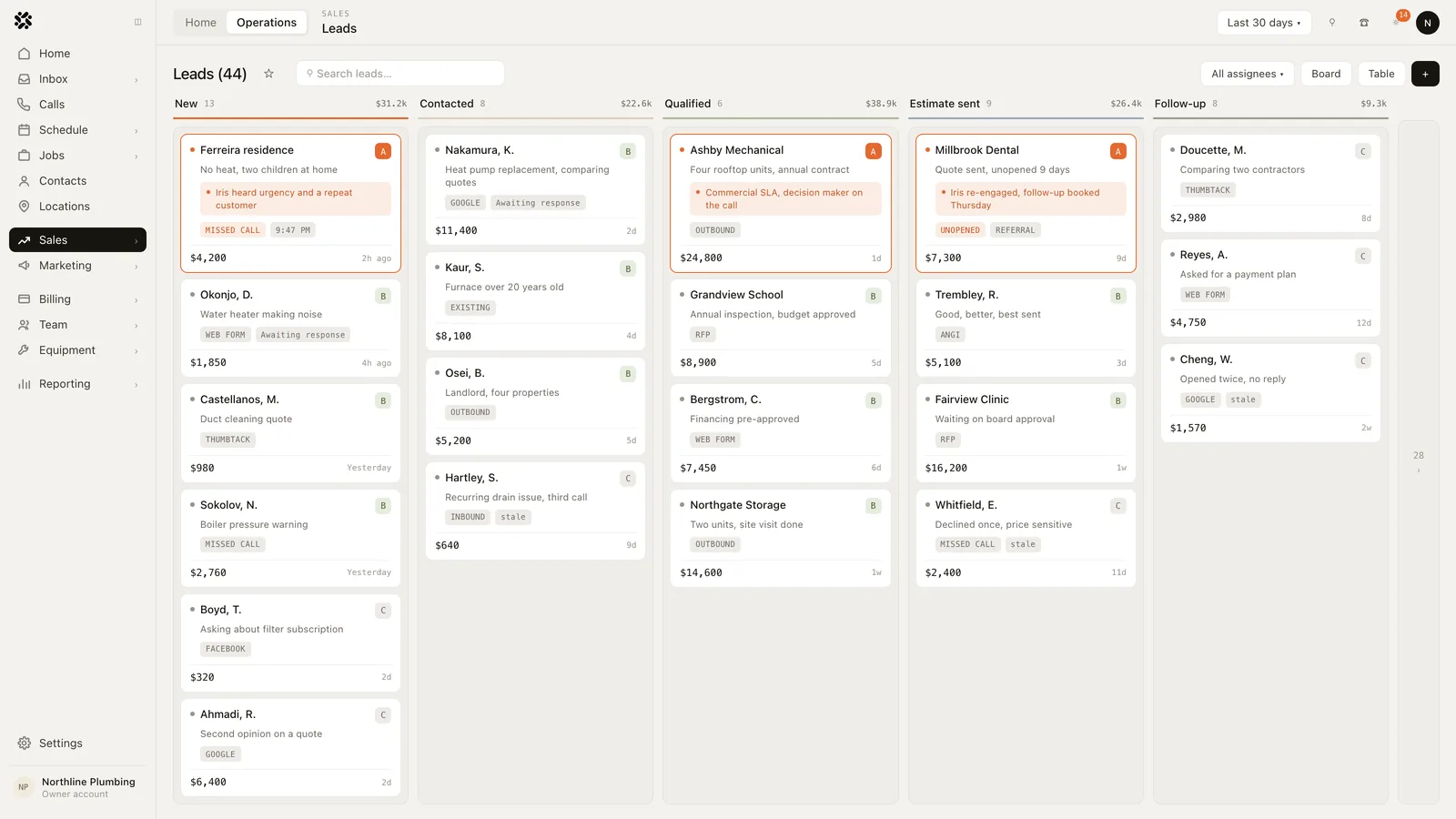
Ours, so weigh it accordingly. The difference worth knowing is structural rather than a feature list: Iris, the AI operator, is inside the same system that holds the schedule, the customer history and the equipment at the address. An answering add-on sits outside your software, so it answers with a script and hands you a message. Iris already knows it is a repeat customer with a fourteen-year-old unit you were at in March, so it books the right job with the right technician.
Residential and commercial shops that have outgrown starter software, are losing real money on the phone, and do not want to run an answering vendor and a field service system as two separate products.
If you are one or two trucks, this is more system than you need and Jobber will serve you better. If you are heavy commercial mechanical with complex project work, look hard at BuildOps and Simpro first. We also do not publish a price table, which some people find annoying, and that is fair.
Easier to judge this one yourself
Take the tour and watch Iris handle a call end to end, or bring a week of your own calls and we will run Notifi against them.
What each one actually does
Price is the easiest thing to compare and the least useful, which is why every other guide stops there. The question that decides this purchase is narrower: does the platform run the work properly, and does it answer the phone from inside the same record?
| Answers the phone | Where the AI sits | Built for | Everything included | |
|---|---|---|---|---|
| ServiceTitan | Yes, through its own AI products | Added to an established platform | Large residential and commercial | No. Modules priced separately |
| Jobber | No | Not applicable | One to fifteen technicians | No. Paid add-ons |
| Housecall Pro | Through an add-on | Outside the core record | Small residential shops | No. Paid modules |
| FieldEdge | No | Not applicable | HVAC and plumbing on QuickBooks Desktop | Quoted |
| Service Fusion | No | Not applicable | Dispatch-heavy teams with big offices | Mostly included |
| Workiz | Call handling and tracking | In the platform, aimed at calls rather than full intake | Small to mid-size residential | No. Per user plus add-ons |
| BuildOps | Yes | In the platform | Commercial contractors, especially mechanical | Quoted |
| FieldPulse | No | Not applicable | Growing shops past starter software | Quoted |
| Notifi | Yes | In the platform, reading the live record | Residential and commercial home services | Yes. No add-on modules |
Narrowing this to a shortlist
Most of that table disqualifies itself quickly if you take four questions in order.
- Are you commercial mechanical? Then BuildOps, and you can stop reading. It is purpose-built for you and we are not.
- Are you under about five trucks? Then Jobber or Housecall Pro. You do not yet have the problems the rest of this list solves, and you would be paying for them.
- Is your software fine and only the phone is broken? Then keep your software and buy an answering add-on. Avoca or Sameday. That is a smaller, cheaper, faster fix than replacing your system, and it is what we would tell you on a call. One thing to know before you sign a year of it: an add-on answers from outside your software, so it books blind and hands your office a message to re-key. If the board is the next thing to break, you will be buying twice.
- Are you residential or mixed, past starter software, and losing money on the phone? Now the field gets genuinely small.
That last case is the one worth working through, because the answer is not obvious from a feature list.
You need two things at the same time. A platform that runs the work properly, meaning dispatch that survives a job running two hours long, memberships, equipment history at the property, job costing you can make decisions from. And a front office that answers the phone from inside that same record, so it books into capacity that exists rather than handing your office a message to re-enter.
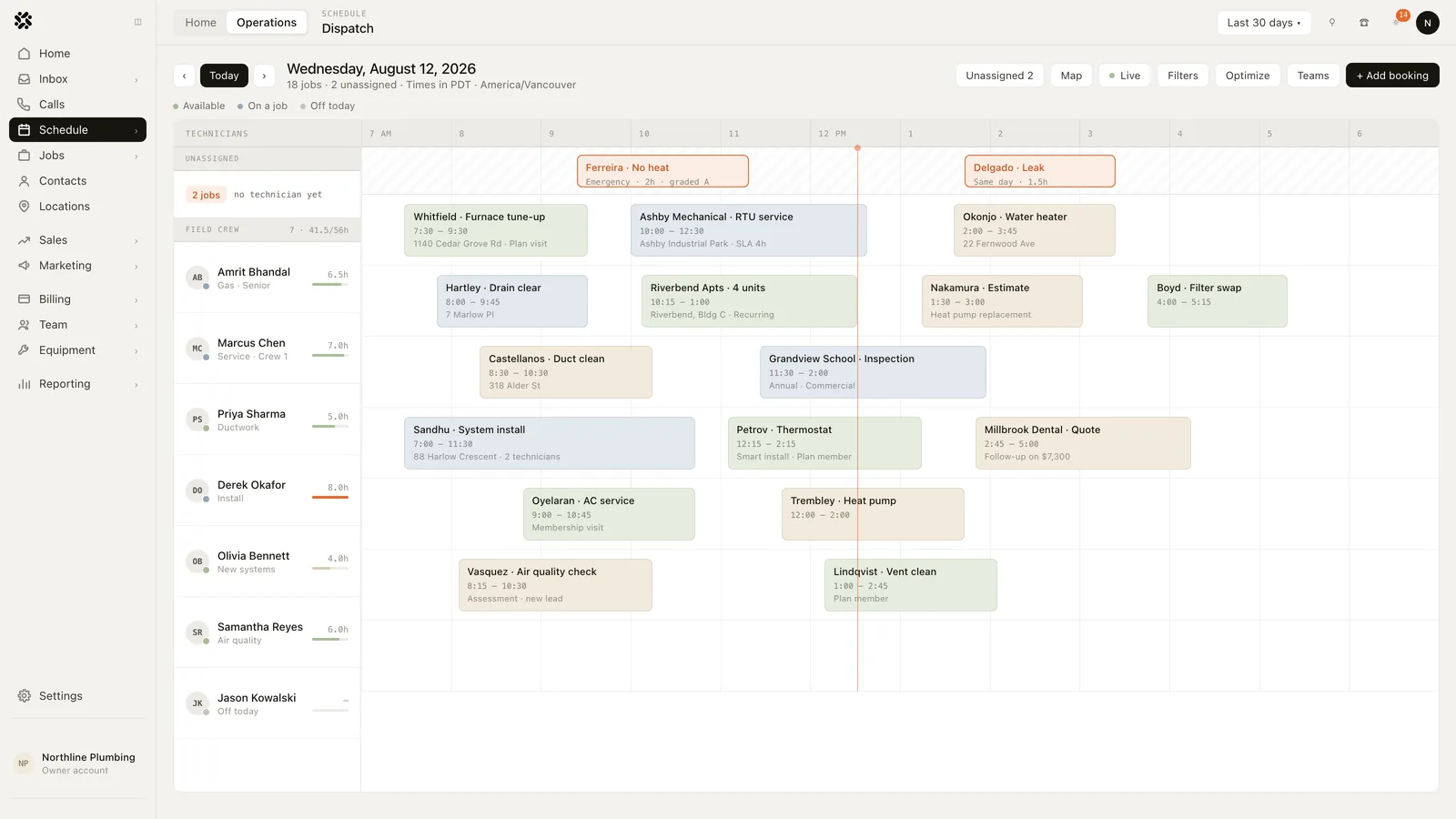
Count how many do both. It is three. ServiceTitan, BuildOps and Notifi.
BuildOps is commercial, so for a residential shop it is out. ServiceTitan does both and does them well, and costs roughly $2,450 to $3,980 a month at ten technicians before the implementation fee, and it expects someone on staff whose actual job is running it. That is a real answer for a lot of companies. It is not a small one.
Which leaves one. The arithmetic above is not ours and the short field is not our invention. It is the reason we built Notifi.
The near miss worth naming is Workiz. It took the phone seriously earlier than almost anyone, and on that dimension it is genuinely ahead of Jobber and Housecall Pro. But on the work side it sits in Housecall Pro's tier, so you hit the dispatch depth and reporting ceiling at the same size you would have hit it anyway. It solves the phone without solving what comes after it.
If that last case is yours, this is the part to check with your own numbers
Bring a week of your actual calls and jobs. We will run Notifi against them and show you what Iris would have booked, and what it would have missed.






How to choose without wasting three months
Pick the one constraint that is costing you the most right now, then shortlist against that alone:
- The phone is the leak, and only the phone. Calls going to voicemail after hours, or the office too buried to call back. Keep your software and look at an answering add-on, or at Workiz if you want it in the platform and are comfortable staying in Housecall Pro's tier on the work side.
- The phone and the board are both the leak. The common case once you are past starter software. Only ServiceTitan and Notifi cover both from one record, so this is where the shortlist gets short.
- The bill is the leak. You are paying enterprise money for a fraction of the platform. Look at Service Fusion and FieldPulse.
- The board is the leak. Dispatch is a person with a whiteboard and a good memory. Look at ServiceTitan, BuildOps and Notifi.
- Nothing is leaking, it is just heavy. Look at Jobber and Housecall Pro and accept the ceiling.
Then make every shortlisted vendor run a real week of your own calls and jobs during the demo. Not their sample data. Yours. The gap between a scripted demo and your actual Tuesday is where switching regret comes from.
Where these numbers come from
Pricing and review figures checked August 2026. List prices are before annual discounts and add-ons, and vendors change them without notice. Verify anything you are about to make a decision on.
Common questions
What is the closest alternative to ServiceTitan?
For commercial contractors, BuildOps is the closest in ambition and depth. For residential companies that want comparable capability without per-technician pricing or a months-long implementation, the realistic set is Notifi, FieldPulse and Service Fusion. Jobber and Housecall Pro are a step down in capability rather than a like-for-like alternative, which is fine if that is what you want.
Is there a cheaper version of ServiceTitan?
Not a cheaper version of the same thing, no. What exists is a set of platforms that cover most of what a growing service company actually uses, without the per-technician model or the implementation project. The saving is real, and so is the trade-off in depth on the most advanced features.
How much does ServiceTitan cost?
ServiceTitan does not publish a price table. Customers commonly report somewhere in the range of a few hundred dollars per technician per month once modules are included, plus a one-time onboarding fee that varies widely with scope. Office staff seats are generally not billed the same way as field technicians. Get a current quote rather than relying on any published figure, including this one.
How long does it take to switch field service software?
Plan on four weeks of real work for a mid-size shop, and treat any promise much shorter than that with suspicion unless you are very small. The variable is almost never the software. It is how clean your customer, equipment and price book data is, and how much of your team you can get into training.
Should we switch in our busy season?
No. Move in a shoulder season if you possibly can. If you cannot wait, run the changeover on a single crew first rather than the whole company.
See it against a real week of your own work
Bring a week of your actual calls and jobs. We will run Notifi against them and you can judge the fit from your own numbers instead of ours.